
Satoshi didn't write a whitepaper about digital gold. He wrote one about electronic cash. That was 2008. Here we are, more than 15 years later, and most people treat BTC like a digital gold bar they're afraid to touch.
A recent GoMining survey of over 5,700 Bitcoin holders puts numbers to what most of us already feel. Nearly 80% say they want broader crypto adoption. But 55% admit they rarely or never use crypto for everyday payments.
The gap between conviction and checkout
Only 12% of respondents use crypto daily for payments. Weekly gets you to 14.5%. Monthly, 18.3%. For most holders, spending Bitcoin is something that happens occasionally, if at all.
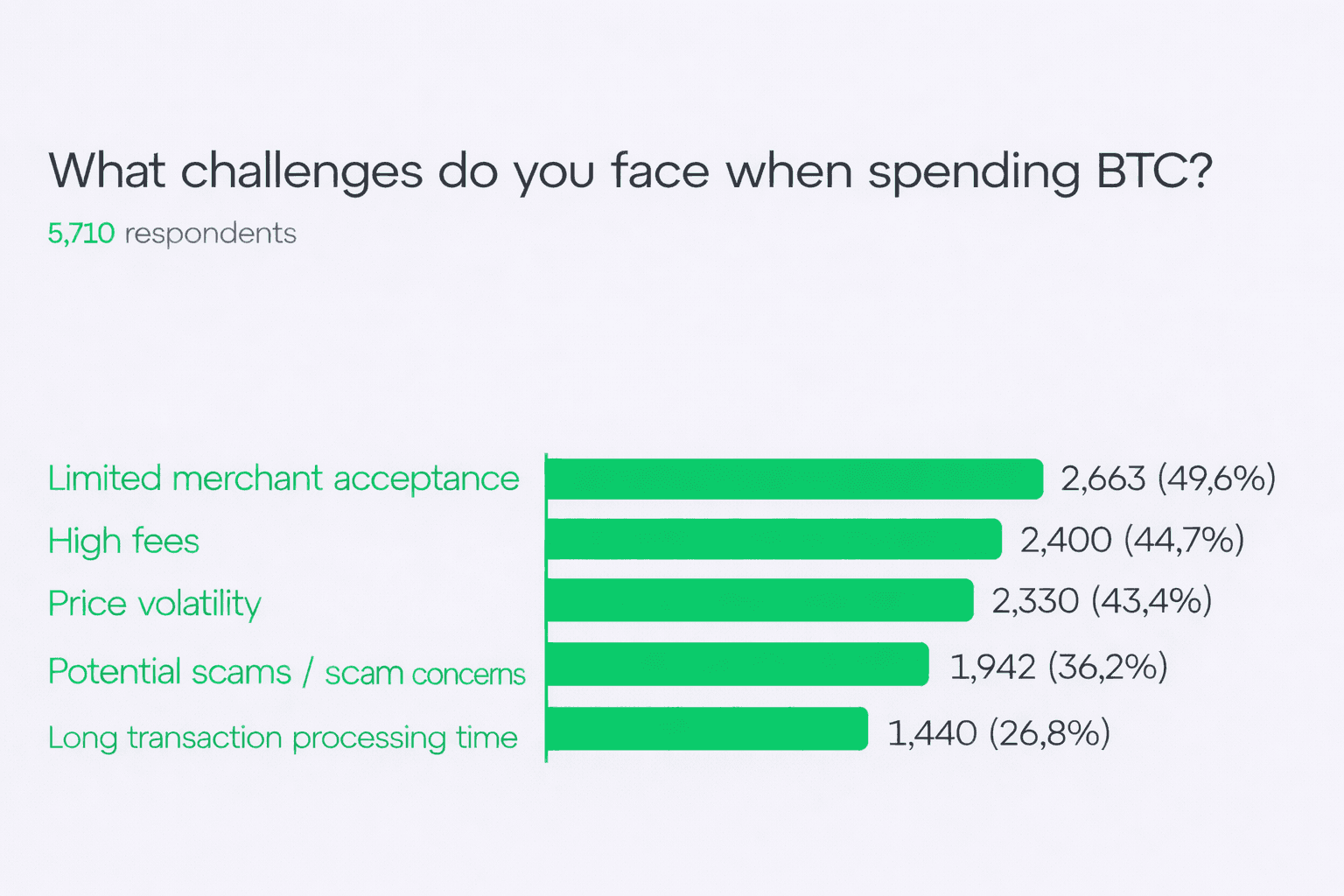
Bitcoin spending barriers. Source: GoMining
The numbers hold across Europe and North America, across first-time buyers and long-term holders. We're not looking at a regional or knowledge problem here. The infrastructure just hasn't caught up with the conviction.
Why holding always wins by default
Ask holders why they don't spend, and the answer is always the same: friction.
Merchant acceptance is the obvious one. Most places still don't take Bitcoin, so you've got the asset but nowhere to use it. Like owning a perfectly good car in a city with no roads.
Then there are on-chain fees that shift with network demand. When the fee on a €3 coffee costs more than the coffee itself, the maths just doesn't work.
Volatility doesn't help either. When BTC moves 5% in a day, spending feels like a bet you're making against your own future gains. So holding wins by default.
And even when someone decides to spend, the experience is fragmented. Wallets, exchanges, spending cards, tax tracking, none of it talks to each other. What should be a tap-and-go moment turns into a five-step process.
How Bitwala closes the gap
Bitcoin payments already work in digital-first environments where the whole transaction stays online. The problem is everywhere else. And waiting for every merchant on earth to accept BTC directly is a nice fantasy, but not a strategy. So we took a different route.
The Bitwala Visa card connects your crypto to the payment network that already exists. Pay with Euro, Bitcoin, Ethereum, or USDC wherever Visa is accepted, online, in stores, at ATMs. Over 100 million merchants, no merchant-side integration required.
With Bitcoin Lightning built in, we cut the fee and speed problem at the source. Instant BTC transactions with minimal fees and no waiting for confirmations. The Lightning Network doing what it was designed to do: making Bitcoin work as peer-to-peer cash.
Hold EUR, BTC, and ETH side by side in the app. Decide at the moment of purchase which asset you want to spend. Switch instantly. No manual conversions, no moving funds between platforms, no guesswork. The card handles it at checkout, so the experience feels like any other card payment.
That solves the core barriers in one go. You're spending wherever Visa works, so acceptance stops being a limitation. Volatility becomes a choice because you pick which asset to spend at checkout. Fees are transparent and predictable. And the complexity of juggling wallets, exchanges, and converters collapses into one app and one card.
Bitcoin doesn't need to replace your credit card. It needs to work alongside it.
You worked for your Bitcoin. Now put it to work.
One card, one app. Pay with Euro, Bitcoin, or Ethereum wherever Visa is accepted and switch between them instantly without manual conversions or extra steps.
You decide which asset to spend and when to spend it. Euro for your morning coffee, Bitcoin for your weekend trip. The point was never to choose between crypto and everyday life. It was to stop having to.